
5 Books Every Black Belt Must Re-Read

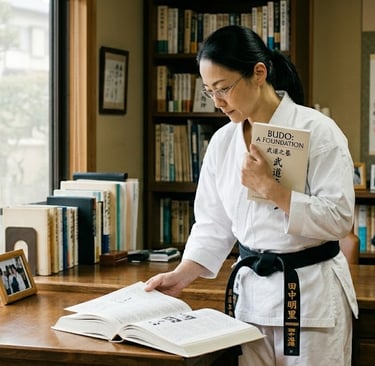
In 2026, the hardest opponent isn't the one in front of you, it's the notification in your pocket. As a sports performance mindset coach, I call this "Cognitive Fragmentation." As a martial artist, and mindfulness coach, I call it a breach in Zanshin. To reclaim our focus, we must return to the analogy scrolls of the master.
In my dual life as a mindset coach and a martial artist, I’ve realized that the dojang (Korean) or dojo (Japanese) is essentially a laboratory for the human nervous system. We step onto the mats to intentionally trigger our stress response, only to practice bringing it back under conscious control. It is the ultimate "Mind-Body" hack.
But lately, I’ve noticed a significant "pain point" in both my clinical work and the martial arts community: The Gray Out
We are so overstimulated by digital feedback and "bio-hacking" gadgets that we’ve lost the ability to drop into deep, sustained focus. We are training our bodies, but our brains are scattered.
If we want to achieve Mushin, that state of "No-Mind" where the subconscious takes over and the body moves with perfect economy, we must feed the brain better data. This is why I believe the physical book is a vital piece of training equipment.
Here are the five books that have been topping the charts on Amazon that I believe every serious practitioner needs to re-read through the lens of neuroscience and mental mastery. As you read, don’t be too concerned about any scientific words you don’t fully understand, you can easily Google search these or drop me a mail at: info@dojangbooks.com
Book 1. The Neural Blueprint of Strategy: The Book of Five Rings by Miyamoto Musashi
Musashi was a master of "predictive processing" centuries before we had a name for it. His Book of Five Rings remains the 1 martial arts book for a reason.
When Musashi speaks of "The Void," he is describing the state of maximum neural efficiency. When you re-read the "Fire" and "Water" scrolls, don’t just look at them as sword tactics. Read them as a manual for Autonomic Regulation. Musashi teaches us how to maintain a "calm heart" even during chaos. In 2026, the ability to keep your prefrontal cortex online while your amygdala is screaming "danger" is the ultimate competitive advantage.
Available on Amazon: View Now
Book 2. Neuroplasticity in Motion: Tao of Jeet Kune Do by Bruce Lee
Bruce Lee was the patron saint of neuroplasticity. His philosophy was simple: "Absorb what is useful, discard what is useless." This is exactly how the brain prunes synapses to create elite-level skills.
The biggest challenge for many students today is "Cognitive Rigidity", staying stuck in a pattern because "that’s how it’s always been done." Re-reading the Tao encourages the "Growth Mindset." It pushes you to perform Kintsugi on your own technique, breaking down old, inefficient neural pathways and replacing them with fluid, adaptive ones, creating endless possibility where there was once, limitation.
Available on Amazon: View Now
Book 3 The Science of the "Struggle": Jiu-Jitsu University by Saulo Ribeiro
As a performance coach, I often see students quit because they can't handle the "ego bruise" of losing. Saulo Ribeiro’s work is a masterclass in Dopamine Management. By breaking the art down into stages, Survival, Escapes, Guard, and Submissions, he provides a roadmap for the brain’s reward system. Many practitioners fail because they try to “Submit” (High Reward) before they’ve mastered "Survival" (High Effort). This book teaches you how to stay in the "struggle" long enough for the brain to learn and rewire. It’s the definitive guide for student retention and long-term grit and perseverance.
Available on Amazon: View Now
Book 4. Somatic Awareness and the Zen Brain: Zen in the Martial Arts by Joe Hyams
We live in an era of "disembodiment." We spend all day in our heads and on our screens, either in the past or in the future. Hyams’ classic is the perfect antidote. It focuses on the psychological and somatic side of the arts, the "felt sense" of training.
From a neuroscience perspective, this book is about Proprioception and Interoception. It’s about learning to listen to the internal signals of the body to achieve a state of Mushin. It’s a short, punchy read that helps you bridge the gap between "knowing" a move and "feeling" it.
Available on Amazon: View Now
Book 5. The Ethics of the Warrior: Living the Martial Way by Forrest E. Morgan
Finally, we have the manual for Integrated Integrity. The biggest "pain point" I see in 2026 is the "Identity Gap", people who are disciplined on the mats but lack self-regulation in their personal lives.
Forrest Morgan looks at how to take the Budo lifestyle into the world. I know that true mental health comes from "Alignment." If your actions in the world don’t match your values in the dojo, you create cognitive dissonance. This book provides the framework to live as a unified, high-performance individual. The way we are meant to live! …
Available on Amazon: View Now
Why the "Analog" Experience is a Neural Necessity
You might ask why a neuroscientist is advocating for paper books in an age of AI. The answer lies in Tactile Encoding. When you read a physical book, your brain uses multiple senses to anchor the information. The weight of the book, the texture of the page, and the spatial location of the text all help "tag" the memory in your hippocampus, the part of your brain to do with memory and learning, the part that turns short term experiences into long term memories. In a world of scrolling, your brain treats information as disposable. In a book, your brain treats it as foundational.
Re-wiring for the Future
Whether you are an instructor trying to help your students find their Ikigai, or a practitioner looking to overcome a plateau, these books are the "Golden Joinery" for your mental development. They help us fix the cracks in our focus and make us stronger in the broken places.
Optimize Your Mental Dojo
The most important belt you will ever earn is the one around your mind. Don’t just train hard—train smart.
I’ve curated the top-selling, scientifically essential editions of these classics at DojangBooks. From the tactical depth of Saulo Ribeiro to the timeless strategy of Miyamoto Musashi, these are the tools you need to harmonize your brain and your body.
Train the mind. The body will follow.
Pages turn slowly,
Neural paths begin to glow,
Ancient mind, reborn.
This post contains affiliate links. Please read our Affiliate Disclosure for full details.