
Finding Your Ikigai Through Martial Arts
4/8/20266 min read

Finding Your "Reason for Being": Ikigai and the Martial Way
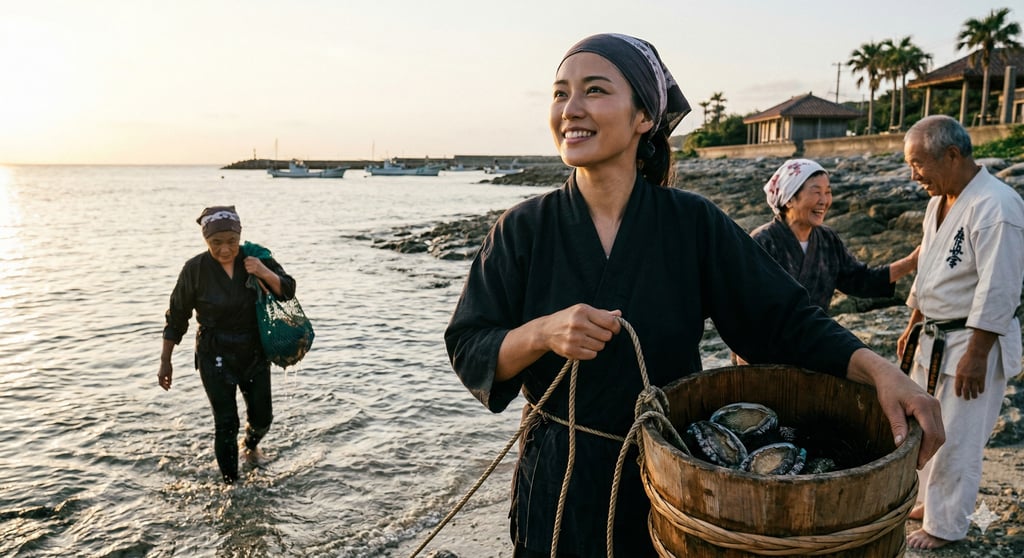
In the sun-drenched coastal villages of Okinawa, the very birthplace of Karate, a remarkable tradition persists. Long before the first light of dawn touches the horizon, a group of women known as the Ama divers prepares to enter the sea. Without the aid of modern oxygen tanks or sophisticated diving gear, these "women of the sea" plunge into the cold depths to harvest pearls, abalone, and seaweed. They rely on ancient "Iso-fue" (sea whistle) breathing techniques and a quiet, steely resolve that has been passed down through generations.
What is most striking about the Ama is not just their physical prowess, but their longevity. Many of these women continue to dive well into their 80s and 90s with the grace of those a third of their age. When researchers ask what keeps them going, they don’t cite fitness metrics or financial necessity; they speak of their Ikigai, their "reason for being." For the Ama, the ocean is where their passion, their skill, and their community converge.
As martial artists, we are on a strikingly similar path. Whether we are stepping onto the mats for the first time or the thousandth, we are searching for that same sense of purpose. We are looking for a reason to endure the sweat, the bruises, and the mental fatigue. We are looking for our own version of the sea.
What Exactly is Ikigai?
The concept of Ikigai (pronounced ee-key-guy) is a culturally rich Japanese philosophy that acts as a compass for a well-lived life. The word is a beautiful compound: iki, meaning "life," and gai, meaning "worth" or "value." Essentially, it is the answer to the question, "What makes my life worth living?"
Western interpretations often visualize Ikigai through a Venn diagram of four overlapping circles. To find your Ikigai, you must identify the intersection of:
What you love (Your Passion): The activities that bring you pure joy and make you lose track of time.
What you’re good at (Your Vocation): The skills, talents, and strengths you have cultivated.
What the world needs (Your Mission): The ways you can contribute to the well-being of others or your community.
What you can be paid for (Your Profession): The practical means of sustaining your life and providing security.
When these four areas overlap, you find the "Sweet Spot." In the center lies a sense of balance, happiness, and profound fulfillment. Without one of these circles, life can feel lopsided, perhaps you are doing what you love but you’re broke, or you’re well-paid but feel like your work has no soul. Ikigai is the pursuit of the "Whole."
Martial Arts: A Living Map to Ikigai
For a martial artist, the dojo is not just a gym; it is a laboratory for Ikigai. Practicing a martial discipline offers a physical and spiritual framework to explore all four pillars of this Japanese secret.
1. The Passion: What You Love
Most people don't start martial arts because they want to work on their "four circles." They start because they fall in love with the movement. They love the snap of a crisp Gi, the rhythm of a heavy bag, or the chess-like complexity of a grappling match. This "vibe", the culture, the history, and the sheer physicality is the fuel. This love is what keeps a practitioner showing up on rainy Tuesday nights when the body is tired and the couch is calling.
2. The Vocation: What You Are Good At
Martial arts training is the ultimate exercise in skill acquisition. Every kata, every spar, and every repetition of a basic punch sharpens your discipline. You begin as a "white belt" in life, acknowledging your weaknesses. Over years of training, you transform raw potential into mastery. This creates a feedback loop of confidence; as you get better at your art, you begin to realize that you are capable of overcoming challenges you once thought impossible.
3. The Mission: What the World Needs
The "lone wolf" martial artist is a myth. Authentic martial arts thrive on community. By being a reliable training partner, you are helping someone else grow. By teaching a self-defense class, you are making your neighborhood safer. Many dojos act as anchors for their local communities, providing a safe space for youth and a support network for adults. When you link your personal progress to the needs of your community, you move from "self-improvement" to "purpose."
4. The Profession: What You Can Be Paid For
While not everyone wants to turn their hobby into a job, martial arts offers a unique path to professional fulfillment. Many practitioners transition from student to instructor, eventually opening their own schools. This allows them to align their financial survival with their deepest passions. Even for those who keep a "day job," the discipline learned on the mats often leads to greater success and earning power in their professional lives through increased focus and resilience.
How to Find Your Ikigai on the Mats
Finding your Ikigai isn't a destination you reach; it’s a way of traveling. If you’re feeling a bit stagnant in your training, you can use these three "black belt" strategies to realign your compass:
Step 1: Set "Ikigai Goals"
Don’t just train aimlessly. To find purpose, you need direction. Use the SMART goal framework—Specific, Measurable, Attainable, Relevant, and Time-bound. However, add an Ikigai twist: ask yourself, "Does this goal serve my passion AND my community?" Whether it’s mastering a specific sweep, earning your next belt, or preparing for a tournament, a clear target creates a clear "reason to get up in the morning."
Step 2: Seek a Sensei (The Power of Mentorship)
In the journey of life, we often get stuck in our own heads. A mentor, a Sensei, Coach, or senior student, is a bridge between who you are and who you want to become. Their wisdom helps you see the blind spots in your training and, more importantly, in your character. A mentor doesn't just teach you how to kick; they show you how the discipline of the kick applies to your patience at home or your focus at work.
Step 3: Embrace the Sangha
"Sangha" is a term often used to describe a community of practitioners. You cannot clap with one hand, and you cannot truly master a martial art in isolation. Engaging with your teammates turns a grueling workout into a shared journey. When you invest in the success of your peers, your own Ikigai expands. You are no longer just training for yourself; you are training for the "we."
Real-Life Stories of the Ikigai Journey
The beauty of Ikigai is that it looks different for everyone. Here are three ways martial artists have found their center:
The Teacher (Hiroshi): Hiroshi began Judo as a child to stop being bullied. He became a fierce competitor, but after a career-ending injury, he felt lost. He rediscovered his Ikigai not in winning trophies, but in teaching. Today, he runs a program for "at-risk" youth, using Judo to teach respect and emotional regulation. His "reason for being" is the light he sees in a student's eyes when they finally stick a landing.
The Healer (Maria): Maria turned to Brazilian Jiu-Jitsu after a period of intense personal trauma. On the mats, she found she could "turn off" her anxiety and focus on the present. As she grew stronger, she realized other women needed this same empowerment. She now runs self-defense workshops for survivors, merging her skill (BJJ) with what the world needs (safety and healing).
The Balanced Professional (Ravi): Ravi is a high-level executive who struggled with burnout. He took up Karate as a way to stay fit, but soon realized the "Zen" of the dojo was the only thing keeping him sane. He didn't quit his job to open a dojo; instead, he integrated his martial arts philosophy into his leadership style. His Ikigai is being the "calm in the storm" for his employees, using the breathwork and focus of Karate to lead with integrity.
Your Journey Starts Today
Like the Ama divers of Okinawa, we don't need to look for a "big bang" moment of enlightenment. We don't need to wait for a perfect alignment of the stars to feel happy. Ikigai is found in the small, daily repetitions—the deep breath before a sparring match, the sweat on the brow, and the bow to your partner at the end of class.
The martial way is a lifelong pursuit of balance. It challenges us to be strong but humble, fierce but compassionate, and individualistic but community-minded. When we align our training with our values, our skills, and the needs of those around us, we stop just "doing" martial arts and start "living" them.
What is your reason for stepping onto the mats tomorrow? Take a lesson from the Ama: dive deep, breathe intentionally, and find your own reason to rise. Find that, and you’ve found your Ikigai.
Dojangbooks.com
Contact
Newsletter
info@dojangbooks.com
© 2026. Anthony Davies. Dojang Books. All rights reserved.