
Have you ever felt like you’re training at 100% intensity, yet your progress feels like it’s trapped in a loop?

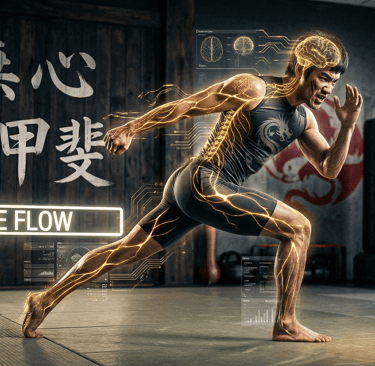
Have you ever felt like you’re training at 100% intensity, yet your progress feels like it’s trapped in a loop?
We have all been here and in the world of professional coaching, we call this "The Plateau." It’s that frustrating moment where physical effort no longer yields a linear return. You’re putting in the hours, the sweat is hitting the dojo, but the needle isn't moving. This is usually the sign that your mental software is no longer capable of running your physical hardware and needs a data update.
I’ve spent my martial arts and coaching life, obsessing over one thing: The Edge. What is the difference between an athlete who excels under pressure and one who folds? To find the answer, I look to the ultimate disruptor of human performance: Bruce Lee.
Bruce Lee was a futuristic thinker. He looked at centuries of rigid tradition and realized they were anchors, not sails. He was a scientist of the human spirit. Today, new modern neuroscience research is finally catching up to the intuitive genius Bruce displayed decades ago.
Here are the lessons that will bridge the gap between your current output and your absolute potential. Lessons that will transform your way of thinking on martial arts and life!
1. The Power of "Formless" Visualization
Bruce Lee’s most famous directive, "Be water, my friend", is often viewed as a poetic suggestion. But in the context of high-performance coaching, it is a masterclass in neural efficiency.
When you train, do you focus on the rigid repetition of a movement, or do you focus on the intent?
The Neuroscience Evidence: Recent studies in brain mapping have found that when an athlete visualizes a movement with high emotional intensity and sensory detail, the brain fires in the exact same patterns as it does during physical execution. This is known as "Functional Equivalence."
Bruce Lee didn't just practice punches; he lived them in his mind. He was "pre-wiring" his nervous system for success long before he stepped under the lights. Coaching athletes to be "like water" helps them relax mental barriers, allowing their brains to choose the easiest path forward.
The Coaching Strategy: Start your sessions with "Dynamic Stillness." As an instructor have your athletes spend three minutes in total silence, visualizing the texture of the air, the rhythm of their breath, and the exact sensation of a successful strike. Or, if you are a student, in doing this, you are designing the victory before a single muscle moves.
2. Discarding the "Neural Noise" (The Art of Subtraction)
In elite performance, complexity is often a mask for inefficiency. Bruce Lee’s core philosophy was clear: "It’s not the daily increase but daily decrease. Hack away at the unessential."
Most athletes and coaches think that to get better, they need to add more: more supplements, more drills, more variables. But your brain has a finite "bandwidth."
The Neuroscience Evidence: Modern research into "Cognitive Load Theory" suggests that performance drops significantly when the brain is forced to process too many variables at once. When you try to track twenty different technical cues during a high-speed sparring session, your prefrontal cortex becomes a bottleneck.
Bruce Lee’s Jeet Kune Do was the "Lean Startup" of the martial arts world. He realized that the most efficient strike was the one with the fewest moving parts.
The Coaching Strategy: Audit the training program. Identify "Legacy Drills", things being done simply because "it’s how it’s always been done." If a movement doesn't serve the direct goal of efficiency and impact, discard it. Subtraction is the highest form of optimization.
3. The Kintsugi Mindset: Embracing the "Break"
In traditional Japanese philosophy, Kintsugi is the art of mending broken pottery with gold. The break isn't hidden; it’s highlighted, making the object stronger than the original.
Bruce Lee was a master of the "Performance Pivot." When he suffered a catastrophic back injury and was told he might never walk again, he didn't enter a state of defeat. He spent that period in bed refining his mental models and writing his philosophies. He filled his "cracks" with the gold of knowledge.
The Neuroscience Evidence: New modern neuroscience research has found that the brain is capable of "Post-Traumatic Growth." When an individual is forced to adapt to a setback, the brain can create denser neural connections and a higher state of cognitive resilience.
As a mindset coach, I teach that a plateau or an injury isn't a wall, it’s a diagnostic tool. It’s the moment where you stop relying on raw talent and start building a more sophisticated, resilient system.
4. Coding the "Interception"
Bruce Lee’s style was Jeet Kune Do, The Way of the Intercepting Fist. The goal was to stop the opponent’s attack before it even gained momentum. In the world of high-level performance, this translates to "Intercepting" the mental state before a mistake occurs.
The Strategy of the Pivot: Bruce was constantly iterating. If a traditional stance didn't allow for a fast exit, he scrapped it. He was essentially rewriting his "code" in real-time.
Modern neuroscience research has found that the brain often initiates a decision up to seven seconds before we are consciously aware of it. By training your athletes to recognize the "tells" of their own self-doubt or hesitation early, you are giving them a futuristic competitive advantage. They aren't just reacting to the game; they are dictating the tempo of the game. It’s a matter of not just traing until you get it right, but training until you cant get it wrong.
5. Intercepting the Ego: The "No-Mind" State
In martial arts, we strive for Mushin (No Mind). In modern psychology, we call this the Flow State. Bruce Lee described it as being a "self-triggering" weapon.
The biggest obstacle to elite performance isn't the person across from you; it’s your own ego. The ego is obsessed with looking good and fearing failure. This creates "mental friction" that slows down the nervous system.
The Neuroscience Evidence: When an athlete enters Flow, modern brain imaging shows "Transient Hypo frontality." The part of the brain responsible for self-criticism and future-worrying temporarily goes quiet. This allows the instinctive, faster-processing centres of the brain to take the lead.
The Coaching Strategy: To reach this state, the training must be "Autotelic", the athlete must be focused on the process, not the outcome. When the desire to "win" is replaced by the commitment to "be," the performance becomes effortless.
6. Utilizing Neural Anchors for Instant Focus
High performance is about state management. Bruce Lee used specific rituals, his focus, his breath, and his vocalizations, to anchor himself into a state of total presence.
The Strategy: Use a technique called "Anchoring." Have your athlete identify a moment where they feel 10/10 in terms of confidence and focus, have them visualise this, feel what they felt, see what they saw and hear what they heard. . At that peak moment, have them perform a small, unique physical gesture (like a specific breath or a snap of the fingers, or step into an imaginary circle of excellence whilst holding of the thumb and finger together in this moment of high emotion).
Through repeated association, this gesture becomes a "hotkey" for the brain. In a high-pressure match, they can trigger that anchor to instantly signal the nervous system to release the neurochemicals associated with peak performance.
The Call to Action: Become the Architect of Your Potential
Bruce Lee changed the way to think about training by proving that the dojang (Korean) / Dojo (Japanese) is a mirror. What happens during a training session is a direct reflection of the internal mental architecture. If your mind is rigid, your performance will be brittle.
My blog’s aim is to help you and your athletes see your "golden seams." Don't just train to fight; train to evolve.
Are you ready to stop training harder and start training smarter?
To truly master the "software" of the warrior mind, you need to go directly to the source of Bruce Lee’s psychological evolution…
The Recommendation: The book "Striking Thoughts" by Bruce Lee
This book isn't a list of techniques; it’s a manual for total human performance. It’s a collection of Bruce's private thoughts on the soul, the mind, and the science of success. For any coach or athlete looking to infuse their training with "formless" wisdom, this is the ultimate playbook…
Available on Amazon: View Now
Keep flowing, keep growing, and always stay innovative.
Tony
This post contains affiliate links. Please read our Affiliate Disclosure for full details.