Excellence in Martial arts and life!

Your Breaks Are Not Your Weakness — They Are Your Gold
6/7/20264 min read
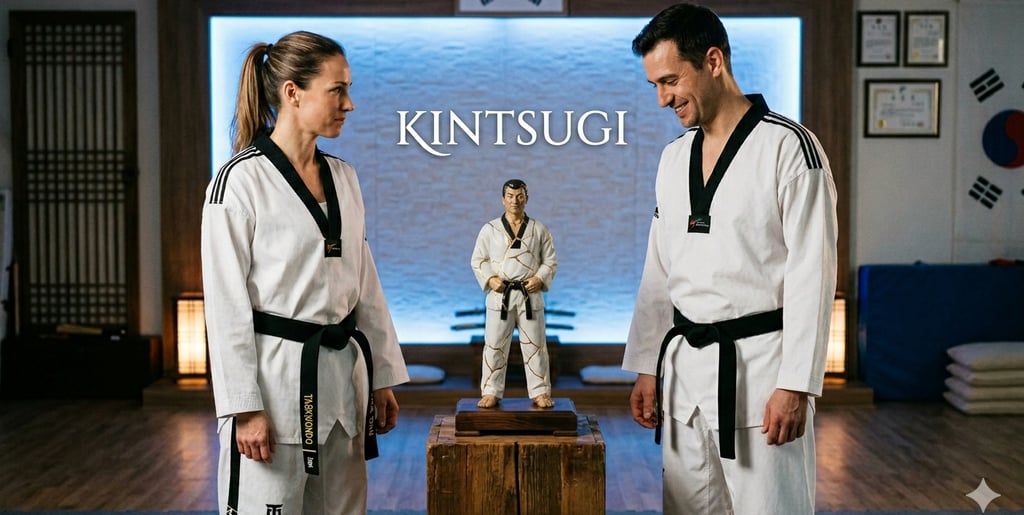
Most of us have felt it.
That quiet, persistent feeling that the broken version of you — the one that carries the weight of failure, loss, illness or trauma, is somehow less than the person you were before it all happened.
Less capable. Less worthy. Less whole.
What if that feeling is not just wrong, but the complete opposite of the truth?
What if your cracks are not your weakness?
What if they are your greatest strength?
The Japanese have understood this for centuries. And they gave it one of the most beautiful names in any language.
Kintsugi.
What Is Kintsugi?
Kintsugi — 金継ぎ — translates as golden joinery or golden repair.
It is the ancient Japanese art of repairing broken pottery with lacquer mixed with gold, silver or platinum. Rather than hiding the damage, disguising the cracks, throwing the broken piece away or pretending the break never happened — Kintsugi does something extraordinary.
It fills the cracks with gold.
The repaired piece is not hidden away in shame. It is displayed. Celebrated. Considered more beautiful and more valuable than it was before it broke, because the history of its breaking and its repair is now visible in every golden line that runs across its surface.
The crack is not erased.
It is honoured.
Why This Changes Everything
Think about how most of us treat our own breaks.
The failed business. The ended relationship. The health crisis. The period of our lives we do not talk about at dinner parties. The mistake we made that we have spent years trying to pretend never happened.
We hide them. We minimise them. We carry them quietly, hoping nobody notices, hoping they do not define us, hoping that somehow, we can present a version of ourselves to the world that looks unbroken.
Kintsugi says — stop.
Not because pretending is wrong. But because it is unnecessary. And because in hiding your cracks you are hiding the most interesting, most human, most genuinely powerful thing about you.
Your breaks are where your story lives.
Your breaks are where your wisdom comes from.
Your breaks are where the gold goes.
The Martial Arts Connection
In the dojang, the training hall, we talk about falling down and getting up again. It is one of the oldest truths in martial arts. Fall seven times. Rise eight.
But Kintsugi goes deeper than simply getting up.
It says that the getting up changes you. That the fall and the rising leave a mark and that mark is not a scar to be ashamed of. It is a gold line running through the ceramic of who you are. Visible. Permanent. Beautiful.
The martial artist who has never been tested knows techniques.
The martial artist who has been broken, by injury, by defeat, by the difficulties that life delivers without warning and who has risen from that breaking knows something else entirely.
They know what they are made of.
And that knowledge, carried in the body, earned rather than learned, is worth more than any technique.
That is Kintsugi applied to a life.
My Own Gold Lines
I want to be honest with you about something personal.
I have my own gold lines.
A childhood marked by violence and trauma that left me mute for months. Years of struggling with literacy that left me feeling less than everyone around me. A stroke in 2016 that paralysed my left side and prompted doctors to tell me I would never walk again.
Each of those breaks felt, in the moment, like an ending.
Each of them turned out to be a gold line.
Not because suffering is good or adversity is to be sought. But because each break, each genuine, painful, undeniable crack in the ceramic of my life, was followed by a repair. And every repair made me something I was not before.
More resilient. More compassionate. More certain of what I value and what I am here for.
More me.
The stroke that nearly took everything became the chapter of my life that clarified everything. The boy who could not read became the author. The broken places became the most important pages of the story.
That is Kintsugi.
And it is available to you, right now, with whatever breaks you are carrying, just as it was available to me.
How to Apply Kintsugi to Your Life
Kintsugi is not just a philosophy to admire. It is a practice. Here is how to begin:
Name your breaks honestly. Not with drama or self-pity, but with the quiet, honest acknowledgement that they happened. You cannot fill a crack with gold that you are pretending is not there.
Ask what the break taught you. Every genuine difficulty contains a lesson, often one that could not have been learned any other way. What did yours give you? What do you know now that you could not have known before?
Look for the gold line. Where has the break already begun to repair? Where can you already see, if you look honestly, the gold beginning to show? It is almost always there. Often, we are too close to the break to see the repair that has already begun.
Stop hiding the repaired version. The Kintsugi bowl is not hidden away. It is displayed. The most repaired version of you, the one that carries the history of your breaking and your rising, is not your weakness.
It is your masterpiece.
Discover More
If Kintsugi has resonated with you, if something in these words has touched a break you are carrying or a gold line you have not yet fully seen, I want to recommend a book that goes deeper into this philosophy and the other Japanese concepts that have the power to transform the way you see yourself and your life.
The Dojang Mind: Born to Win — Tony Davies
Part memoir, part philosophy, part practical coaching guide. The story of how ancient Japanese wisdom and modern neuroscience transformed one man's life completely and how they can do the same for you.
Kintsugi is just one of the concepts explored in depth. You will also discover Ikigai, Mushin, Kaizen, Zanshin, Gaman and Wabi-Sabi, each one a tool for building a life that is not diminished by its breaks but made richer and more beautiful because of them.
Available now on Amazon in paperback and Kindle eBook.
This post contains affiliate links. Please read our Affiliate Disclosure for full details.
Dojangbooks.com
Contact
Newsletter
© 2026. Anthony Davies. Dojang Books. All rights reserved.